Research
I am interested in information visualization with special focus on visualization of large data.
My other research interests include visualization in general, human-computer interaction and user interfaces.
Information visualization transforms data to a graphical form. Most people are familiar with pie charts or bar charts - the simple forms of information visualization. The whole thing starts to get messy when trying to visualize data with multiple dimensions, large number of entries or different types of data values (continuous, categorical etc.) This is where the fun begins.
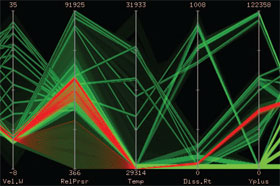
Outlier-Preserving Focus+Context Visualization
![]() |
The approach introduced in this research project detects outliers before creating abstract
representation of data. In addition, the presented technique allows for various levels of
detail in the context part of the visualization. The resulting display treats outliers separately
and preserves them. The visualization is output-oriented, which means that only those parts
of the view that affect the final rendition are actually updated. Altogether, this creates a
display that is capable of showing important fine details (outliers) together with context and
focus in a large data environment.
This project made it into an IEEE Visualization 2006 submission and was published in the IEEE Transactions on Computer Graphics and Visualization. |
Similarity Brushing
![]() |
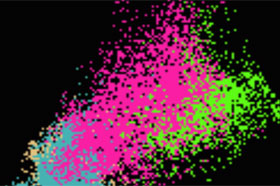
Many information visualization tools discard important multidimensional information by projecting to a low-dimensional display.
I tried to preserve the multidimensional information and display them in a two-dimensional scatterplot. The SimiBrush tool
provides an interactive way to inspect multidimensional similarities and clusters in a low-dimensional display. Complex structures
can be selected (brushed) and segmented out using this tool. Relations that were hidden by the low-dimensional projection now
stand out. The results were presented at the International Conference in Central Europe on Computer Graphics, Visualization and Computer Vision and was published in the Journal of WSCG. Here is a webpage with online presentation of the ideas. |
Visual Abstraction for Information Visualization of Large Data
|
The motivation of this work was to clean up an overplotted parallel coordinates display. Parallel Coordinates are a popular
and effective information visulization tool. However, the display gets easily cluttered by large data. We clustered the
data before the visualization and only displayed the clusters with details on demand. This enhanced the standard parallel
coordinates and enabled us to display large number of entries in a clear and fast way. The project, supervised by Robert Kosara, was the topic of my master thesis and the related CESCG 2004 submission won 3rd prize in both Best Paper and Best Presentation categories. |